Many object-based history books begin with artifacts: a shard of pottery, a buried seal, a carbon-dated bone. But there’s another way to illuminate a civilization’s past – through the memory it has preserved generation after generation, in scripture rather than soil. Sanatan Dharma, more commonly called Hinduism, makes this case as directly as any living tradition does.
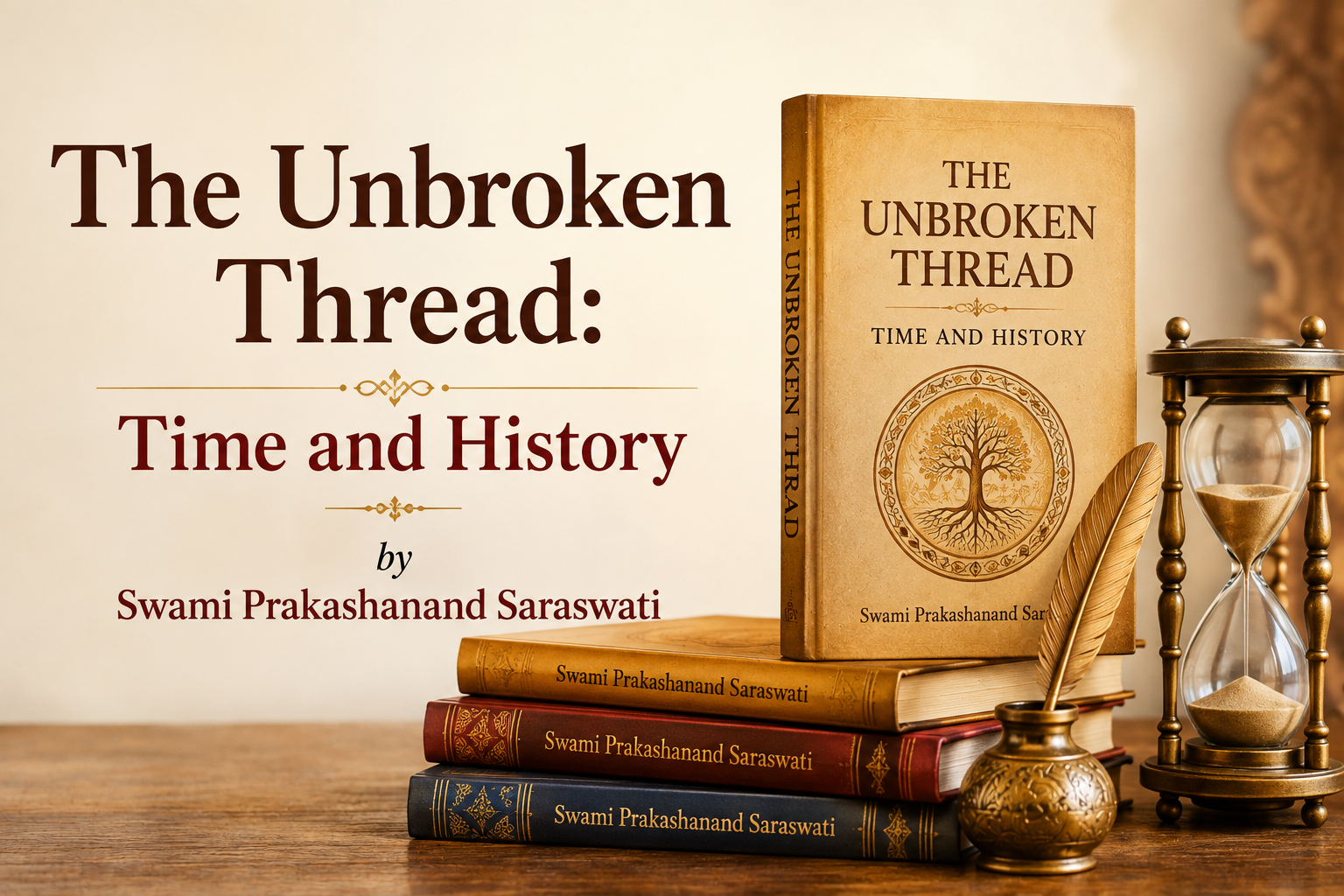
This way of framing history as a continuous, unbroken transmission rather than a set of disconnected fragments is highlighted by the teachings of Swami Prakashanand Saraswati. A Hindu spiritual teacher and author, Saraswati explained the vision of Indian civilizational continuity in detail in his book, The True History and the Religion of India. In it, he illustrates Sanatan Dharma’s own account of its history and cosmology, which we have used as the framework for this blog.
History as More Than Kings and Conquests
A civilization’s history isn’t only the record of who ruled and when. It is incomplete without the lineage of its sages, seers, and spiritual teachers – the people who shaped how a culture understood meaning, duty, and the divine. A timeline of dynasties tells you who held power. It doesn’t tell you what people believed, how they prayed, or why a philosophy survived for millennia after the empire that housed it turned to dust.
As Swami Prakashanand Saraswati explains, Indian civilization carries an unusually continuous thread for this reason. Geography plays a role too: much of the subcontinent escaped the kind of catastrophic ice age disruption that reshaped Europe and North America, which is why its cultural memory carried fewer hard resets across such a long span of time.
Time on a Different Scale
This worldview departs from conventional history in its treatment of time itself. Western historiography works in centuries and millennia, a few thousand years of written record, extrapolated backward with archaeology. The Puranic tradition, as Swami Prakashanand Saraswati discusses, works on a vastly different canvas.
In this cosmology, time moves in nested cycles:
- A chaturyugi, roughly 4.32 million years, is the basic unit.
- A manvantara strings together about a thousand of these.
- A kalpa, the largest cycle, is a single “day” in the life of Brahma, the creative principle of the universe, itself lasting over 4 billion years.
Brahma’s full lifespan runs into the hundreds of trillions of years. Creation and dissolution are not one-time events but a rhythm that has always been happening and always will. This is a direct contrast to the linear “beginning and possible end” implied by modern Big Bang cosmology, which Swami Prakashanand Saraswati rejects in favor of an eternal, cyclical universe.
A culture that measures its own memory in cosmic ages rather than centuries relates to its past on an entirely different scale than one that doesn’t.
Preserving Memory Without Monuments
The tradition raises a genuinely interesting historiographical problem: how do you preserve a reliable memory across a span of time so vast that no physical object, no stone, no manuscript, no monument, could survive it intact?
The answer Swami Prakashanand Saraswati provides is devotional, not archaeological. Great sages, appearing across ages, received and re-transmitted this knowledge in each era, encoding it into texts like the Puranas and Vedas so that it could be renewed rather than merely preserved. The Puranas themselves reflect this layered structure: the deep past is sketched only briefly, the “present age” of Brahma gets much more detail, and the most recent era, the age of Kali, is described in the greatest depth. This is less a single ancient record than a manuscript that has been recopied and annotated by each generation that received it.
Why This Framework Matters
This traditional, faith-rooted account of history and cosmology, as explained by Swami Prakashanand Saraswati, surpasses mainstream archaeology and cosmological science, which date the universe to roughly 13.8 billion years and place the earliest evidence of Indian civilization, like the Indus Valley sites, at a few thousand years BCE. Readers interested in the scientific consensus on cosmology or the archaeological record of South Asia should look to those fields directly.
Setting the historical claims aside, the underlying instinct still holds value: a people’s self-understanding is shaped as much by its philosophical and spiritual inheritance as by its political one. Puranic cosmology, read as literal history, as sacred metaphor, or as a window into how a civilization chose to remember itself, offers something modern historiography often leaves out: a sense of time not as a bare sequence of facts, but as something meaningful, cyclical, and worth passing on.
Conclusion
Swami Prakashanand Saraswati’s illumination offers a different lens on what history is for. It is not only a ledger of dates and rulers, but a living memory carried forward by sages and scriptures, meant to remind each generation where it comes from and what it holds sacred. The unbroken continuity of Bharatvarsh, then, is not a historical claim to be proven or disproven so much as an invitation to see time itself as cyclical, meaningful, and worth honoring rather than merely measured. This perspective is a valuable reminder that every culture’s sense of its own past shapes how it understands its present.